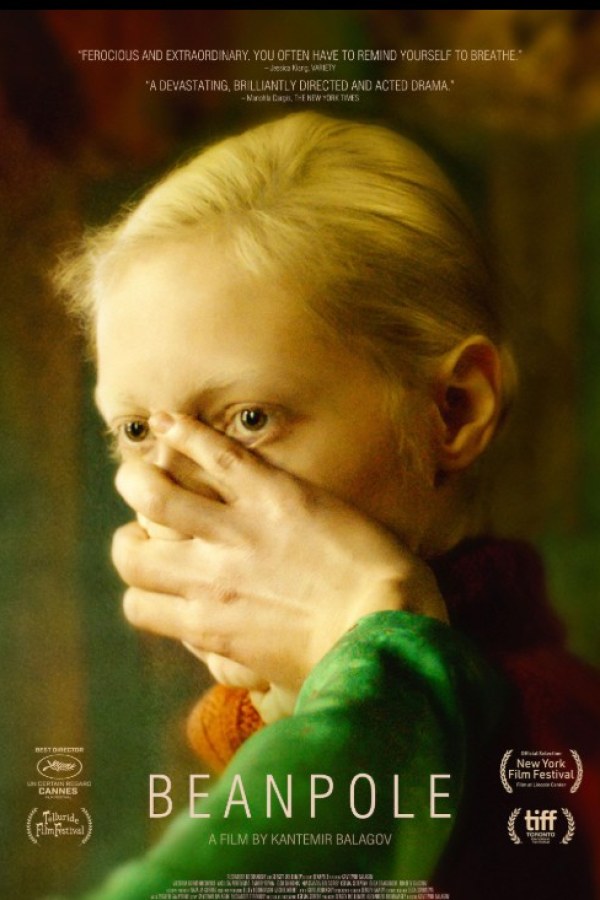
🎬Beanpole
In Leningrad, 1945, World War II has left the city shattered and its survivors emotionally scarred. Iya (Viktoria Miroshnichenko), a extraordinarily tall young woman nicknamed "Beanpole," works as a nurse in a crowded military hospital while caring for a young boy named Pashka. Discharged from the frontline due to severe PTSD, Iya suffers from sudden, paralyzing "freezing" fits where she locks up completely, helpless to move or react.
Tragedy strikes during one of Iya’s involuntary fits, resulting in Pashka's accidental death. Soon after, Masha (Vasilisa Perelygina)—Pashka’s true mother and Iya’s comrade from the frontlines—returns to Leningrad after serving as an anti-aircraft gunner. Devastated by the loss of her child and unable to bear another due to internal war injuries, Masha forces Iya into a dark, desperate pact to carry a baby for her, binding both traumatized women in a complex web of guilt, dependence, and survival.
💡 Did you know?
Inspired by Nobel Laureate's Work: The narrative was deeply inspired by Belarusian Nobel Prize winner Svetlana Alexievich's seminal oral history book The Unwomanly Face of War, which documented the brutal, erased experiences of Soviet women during WWII.
Cannes Un Certain Regard Winner: Kantemir Balagov won the Best Director Award in the Un Certain Regard section at the 2019 Cannes Film Festival, establishing him as one of European festival cinema's premier young talents.
Striking Ocher & Emerald Palette: Cinematographer Kseniya Sereda (who went on to shoot HBO's The Last of Us) intentionally relied on rich, highly saturated ochers, terracottas, and vibrant greens to contrast the gray, muddy post-war Leningrad reality with the burning emotional intensity of its characters.
Oscars Shortlist: Beanpole was selected as the official Russian entry for Best International Feature Film at the 92nd Academy Awards, successfully making the December 15-film shortlist.
⭐ Film Evaluation & Ratings 📈
⭐ Global Critical Consensus: 8.3 / 10 (94% on Rotten Tomatoes)
Widely recognized as a modern masterpiece of post-war cinema. Film critics lauded the astounding debuts of lead actresses Viktoria Miroshnichenko and Vasilisa Perelygina, alongside Balagov's uncompromising directorial vision.
🎨 Visual & Production Aesthetics: 9.1 / 10
Kseniya Sereda’s precise camera composition and the film's lush color theory turn cramped communal apartments and sterile hospital wards into canvas-like psychological spaces.






Comments
No comments yet. Be the first!
Leave a comment